img_3019

We were deep within the wild, winding around the sides of a mountain with tall trees above, boulders alongside the path and enclaves and drop offs at every turn. My hiking partner claimed to know his way around this particular spot, pointing at the blazes which clearly marked the various trails. He was supremely confident that he could walk us in and back out of the seemingly endless supply of nature.

It wasn’t long before we were lost. My fearless guide was momentarily confused when he discovered we were not headed the right direction, which didn’t make me feel all that great. After turning in circles and a few false starts, he let out a slight sigh of relief and pointed again at a blaze on a tree just ahead of us. Somehow, we’d missed one of the markers and accidentally began trekking down a different trail. We were halfway down by the time we realized it. The only way to get back to where we wanted to go was to backtrack until we were back to the point where the trails split. The bad news is that we had to retrace our steps, and we lost some time. The good news is that there were clear markers to follow, and we had little trouble course correcting safely.

What a powerful analogy for dealing with a painful past, a problematic present and an uncertain future.

In Jeremiah 31:21 it says “Set up signposts, make landmarks, set your heart toward the highway, the way in which you went.” God was telling his people to clearly mark the path they took as they were led into captivity, because the way to freedom would require them to return the very way they came. Breadcrumbs, like Hansel and Gretel. Blazes, like the ones marking trees on wooded mountain trails.

Our past can be littered with regrets, failures, mistakes, transgressions, betrayals. At some point, we stepped off the path, or wandered onto a completely separate path that leads far away from what God had for us. We wake up one day, open our eyes and we realize we’ve lost our way. And we wonder how in the world we will find our way back. It’s one step at a time. And it requires us to retrace our steps. And unfortunately, it requires us to use the things that create the most pain, shame and embarrassment as landmarks and guideposts. The only way out is through. To recover from a past we’d rather forget, we must first backtrack, passing by each major misstep to gain understanding, find closure and connect more dots to our story. Our freedom requires us to rediscover the journey that led us to captivity in the first place.

With every step, we move closer to the path we were supposed to take, the path that leads forward. It can feel like we’ve been condemned to wander this regretful road for the remainder of our existence, but it’s a temporary setback in the end. If we engage it, one day we will take the next step and feel a change in the ground beneath our feet. There will be a new blaze on the tree in front of us. A different color that signifies we are no longer retracing. A signal that we are stepping out of the past and into the future that God has waiting for us. And with the understanding of where we came from, we will be better equipped to stay on this path, appreciate it and make the absolute most out of it.

Wherever you are will absolutely lead to where you want to be. Just turn around, start backtracking and let God handle the rest.
dsc_0046

Today’s post will be a little shorter than usual. Just getting right to the point with this one.

Over the last year, I’ve learned a lot about myself. My past. My future. My present. How to live life. How to trust God. How to make sense of things that don’t make sense. How to be present. Along the way, I’ve picked up some effective ways to help me zero in on what I’m feeling and more importantly, help me say or do the next right thing. This doesn’t mean I always say or do the next right thing. But with every passing day, I get better at that.

Here are the three small phrases that are currently making a big difference in my life, and I think if you try them out, you’ll see they will make a big difference in yours as well.

  1. But Why… Whatever you are thinking or feeling, whatever emotion is rising up within you,  it is the product of an unmet need and/or an unhealed wound. Usually, there are layers upon layers that we have to peel back before we get to the bottom of it. When you catch yourself overreacting to a situation or feeling something that is unsettling, or being tempted to do something that isn’t good for you, pause for a second and ask, But why?” Try to uncover what’s driving your bad mood, your craving, your unhealthy response or your negative thoughts.
  2. So That… This is a powerful one. Everything happening in your life right now is under the specific instruction of a power higher than yourself. Ask what God has for you in this current situation. Whatever the trial, obstacle, adversity or suffering you find yourself in, there is a “so that” to it. I heard this phrase for the first time while attending my local church several months ago. Liked it so much, I stole it and have been using it ever since to remind me that even when I don’t understand what God is doing, there is a point to it. A bigger picture. I just have to be patient enough to let Him work.
  3. And Then… I use this when faced with choices and decisions. What is the likely outcome, consequences, etc. to choosing path a over path b. If you are in pain and wanting to medicate in any way to avoid it, you must know that the pain will still be there waiting on you when you’re done, and you’ll also have the consequence of your medicine of choice (which depending on the individual ranges from alcohol to drugs to pornography to binge eating to shopping to gambling to burning hours on social media). If you respond to your current situation out of an unstable emotional state, you will damage the relationship or the scenario even further. Sometimes just being able to see the potential fallout from an unhealthy decision is enough to help you make a healthy one instead.

All three of these phrases are a part of my daily vocabulary now. I’m doing my best to be present in my decision making, in my daily actions, in my relationships, in each and every hour I’ve been blessed with from above. Too often, we go through live in reaction mode, with no real perspective on what is happening to us, why it’s happening and what will happen next. Practice these three phrases for a week, each and every time you get the opportunity, and I bet you feel better equipped to deal with your life in a positive way.

Waking Up to the Echoes_The Long Tail of Sin

I recently watched a television special on ESPN featuring the story of Southern Methodist University and its football team’s infamous journey from rising national powerhouse to being wiped off the map by the NCAA’s death penalty in 1985. For all the non-sports fans out there, SMU cheated in 100 different ways to build a winning football team, and after several rebukes by the NCAA, its program was effectively destroyed by the harshest punishment in NCAA history. The program is only now showing signs of life, more than 30 years later.

Many of the people who created the cheating culture and conducted the majority of illegal and unethical behavior were long gone by the time the NCAA brought down the hammer. The head coach who was there when the ship finally sank wasn’t the one who set course for the iceberg. He just couldn’t steer the ship clear in time. That fate had been set in motion and could not be avoided.

This is a great example of the long tail of sin. The echoes that mistakes can make in times to come. The consequence, sometimes delayed, of regrets, wounds and weakness.

It can seem unfair, when the echoes come. When you think you’ve seen the worst of it. So relieved to have it behind you, whatever “it” is, and to be starting over. But the consequences aren’t always immediate. Sometimes, your mistakes set into motion a series of other painful events that are yet to unfold in your life. The tendency, at least for me, is to then ask God what in the world He thinks He’s doing. Why is He continuing to punish you for the mistakes you made? Why is some of that punishment delayed? Why now? Why isn’t He restoring instead of destroying? Why is He hurting (you and others) instead of healing? Why is He not choosing to create a happy ending here? We expect that once we’ve repented, once we’ve made amends, once we’ve given it all up to God, it’s time for the miracle, the redemption. That is all true. But if the ship has been directed at an iceberg, God makes no promises that you won’t still hit it.

“Your affliction is incurable. Your wound is severe.”

That’s a quote from Jeremiah 30:12-18. This passage says that you’ll be bound up, have nothing to heal you, be forgotten by your lover, all because of the multitude of your iniquities and the increase of your sin. And then, it asks a hurtful question.

“Why do you cry about your affliction?” As if it should be assumed that this is happening.

At the end of the passage, after explaining that you are receiving grave consequences because of your sin, it says God will “restore health to you and heal you of your wounds.” Those incurable, self-inflicted, devastating wounds. God’s plan is perfect, even though it can be painful.

Another passage, Malachi 2:13-15,  says, “You cover the alter of the Lord with tears, with weeping and crying; so He does not regard the offering anymore, nor receive it with goodwill from your hands.” As you read along, it continues, “Yet you say ‘For what reason?'” The passage answers the question, stating that the Lord has been witness to your transgression.

Alexander MacLaren is one of my favorite commentators on scripture. In his examination of these verses, he says:

“Every sin draws after it evil consequences which work themselves out” in your life. “The miseries which follow our sins are self-inflicted, and for the most part automatic.”

In other words, you will reap what you sow. I guess that cliché is true after all. He continues, “If we understand the connection between sin and suffering, and the fact that the sorrows which are but the echoes of preceding sins have all a distinctively moral and restorative purpose, we are prepared rightly to estimate how tenderly the God who warns us against our sins by what men call threatenings, loves us while He speaks.”

And just like the previous scripture in Jeremiah, there remains a promise for redemption.

“No sin can stay our reception of a multitude of good gifts,” said MacLaren.

Sorrows as echoes of preceding sins. That’s really hard to accept. Especially when you feel like you are no longer the person who set the ship on a collision course with the iceberg in the first place. When a changed heart, and a revived spirit is within you. When you’ve begun to transform your life. When you do the work. You likely expect it’s now time for restoration, hope, reward, joy. Not the beginning of an even more difficult journey.

Sometimes, that is true. And sometimes, the long tail of sin still has to work its way out of the picture. And the tip of that tail is most likely the most painful part of it.

I encourage anyone out there who is trying to change, to rebuild, to make things better, to understand that the echoes won’t last forever. At some point, you’ve hit the iceberg, put the pieces back together, and you start winning again. It may feel like forever. But the consequences will work themselves out in your life. In the midst of the echoes is not the time to give up on your God. Even if you are losing what you dearly love. It’s exactly the time when He’s getting ready to do His most miraculous work. It’s not a convenient process. But you can’t argue with the conclusion.  It’s hard. It hurts. I don’t know why things are unfolding as they are for you. I can’t even begin to answer that question for myself at the moment. But I want to see how the story ends. God tells great stories.


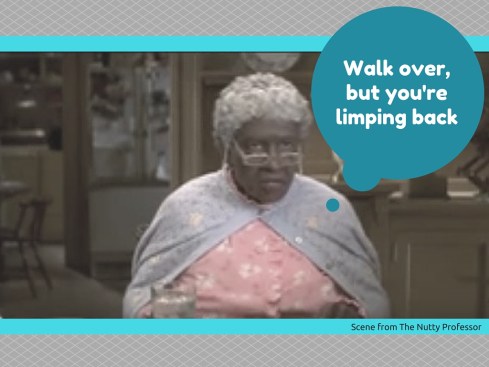
Walk over, but you're limping back!

One of the funniest 3 minutes of cinema, in my humble opinion, is a dinner scene in The Nutty Professor, where the grandma of the family challenges her son, Cletus, to come around to her side of the table to settle an argument. She tells him with extreme confidence that “you walk over, but you’re limping back.”

It’s pretty scary, entering into a fight against an opponent you know you can’t beat. They will impose their will on you. They will defeat you. There’s no way to escape affliction. Cletus knew what his mom said was the truth. If he walked over, he’d be limping back!” He talked a good game, but in the end, he let that fear nail him to his seat. He was not about to get within arms reach of that feisty old lady.

I can identify with Cletus. With the fear he felt. It’s the same fear I felt when God was summoning me to engage with Him. To come around the table and wrestle with Him.

Jacob famously wrestled with God and forever walked with a limp afterward, a continual reminder of the wisdom he received during that encounter. No doubt, if you come around the table to wrestle with God, you will limp back. It’s a fact. I knew this was the truth. Like Cletus, I sat in my chair and refused to move closer to God. Not wanting to be afflicted with a limp.

This is where the comparison with Cletus ends. It was probably a smart move for him to stay seated. But when it’s God and not Grandma issuing the challenge, not answering the call is short sighted at best. The alternative, if we refuse to wrestle, is to be caged by sin. Paralyzed by fear, shame, guilt, resentment and a host of other negative emotions. Enslaved by our past, taken out by our wounds.

It’s okay to be afraid. But here’s what you have to do about it:

It is a fearful thing to fall into the hands of the living God…do not cast away your confidence…you have need of endurance, so that after you have done the will of God, you may receive the promise. – Hebrews 10: 31-36

It is an illusion to believe that we are walking just fine without God. If we try to just go along with our life, just push down the darkness, just shove those painful memories in a corner, just minimize and rationalize our behavior, just ignore the hurt, we in essence will be rendered unable to walk at all. Emotionally crippled. Paralyzed. Because we didn’t want to endure the pain of walking with a limp. Of engaging in our own work, dealing with our own stuff, and allowing God to touch us in a way that marks His purpose in our lives.

I currently walk with a very noticeable limp. I’ve had to face fears, insecurities, wounds, trauma, abuse and a rash of poor decisions and regrettable actions on my part. I have wrestled with God, continue to do so. And my flesh is losing the fight. That’s a good thing. It hurts. I’ll never walk the same when I’m done. But that’s a good thing. A really, really good thing. Sure beats not walking at all.


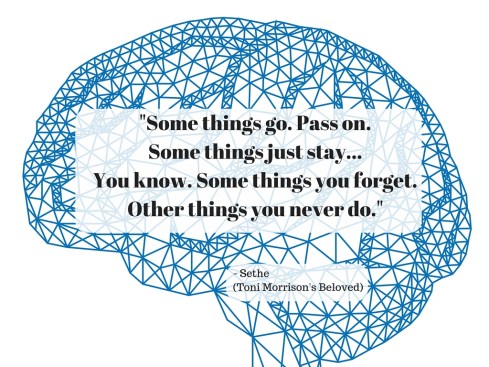
_Some things go. Pass on. Some things just stay... You know. Some things you forget. Other things you never do._ - Sethe in Toni Morrison's Beloved..jpg

In the book Beloved, the main character, Sethe, wrestles with how she can prevail over the trauma of slavery while the memories are still alive and well. Many of us have this struggle. How do we overcome the past, when it still holds influence over us?

I’ve talked before about what many wise men and women have said and written…you don’t need to erase the past or block it out, or forget it. You need to embrace it, use it, and let it appropriately inform your future. Who we are is a direct result of where we’ve been and what we’ve experienced. Good. Bad. Ugly. Every mistake, every poor choice, every act of abuse or betrayal or trespass, it’s all been used to design you and equip you for your God-given purpose.

This means many of us need to closely examine how we treat the past, because we’ve likely made the mistake of letting memories (particularly bad ones) continue to derail us in our daily lives. To hold us down and oppress us. To define us. To strip hope, peace and joy from us. To poison our thoughts. To haunt our dreams.

We have to stop using our memory as a torture device, or a shaming technique, as evidence to substantiate the lies we tell ourselves, as an escape from reality, as an excuse for a pity party, as a cage that renders us helpless and depressed, as a way to keep score and justify our victim hood, or as a glass ceiling that limits our future potential.

Instead, we should leverage our memory positively to retain and recall the lessons we’ve learned, to keep us humble before God, to keep us filled with gratitude, as a means of instruction for others and ourselves, as a counter balance to irrational present thoughts or future tripping, as a detailed ledger of our strengths and our weaknesses, as a way to measure how far we’ve come and how far we still need to go.

Memories can be an extraordinarily powerful tool for our healing and our health. They can also be a cancer that gnaws at us from the inside and blinds us from all that is beautiful about ourselves, our lives and the world around us. Some things just go. They don’t hang around in our memory. Some things do. I strongly believe any memories that are strong enough to stay with us (good or bad or ugly) are to be used for a greater purpose. They have magical powers waiting to be harnessed. But like any superhero, we have to use that power for good and not in destructive ways.

Just a quick word of encouragement…regardless of how much trauma lives on in your memory…today you are blessed beyond measure. Air filling your lungs. Beauty filling your eyes. Music filling your ears. You can choose joy. You can leave the pain behind while you carry its scars. You can actually use the past to create more of the joy you seek now. It’s all about perspective. Trust me, it’s not easy. It’s a daily discipline. I’m not fully executing on it at the moment, which is why I needed to get it down in a blog post and place it in front of me. I needed a reminder today. Maybe you did too?


sty

I posted this picture on my Facebook page earlier this week. Here’s the story behind it and what it means to me.

Several months ago, I attended a weekend retreat with a group of men. We processed a lot of emotions, feelings, past traumas and basically just worked really hard to get a better handle on our fears, wounds, resentments and character defects. It was a pretty intense two days, and there were many deep conversations, inward reflections and buckets of tears.

I left that weekend with a better appreciation for who I am as a man, a clearer view of how my past has shaped me (for better and for worse) and what I need to specifically work on as I stepped forward with my life. I also brought home a souvenir from all my tears. A stye in my right eye.

At first, I just ignored it and assumed it would subside over time. It did not. I went to a couple of eye doctors, who gave me instructions for healing it, including taking medications and applying a warm compress. I tried both, but neither made a difference. So, I ignored it some more. Then, I went to an ophthalmologist for a closer look. He advised me to follow up with their surgical specialist to see about removing it. I scheduled an appointment. Rescheduled it. Cancelled it again. Scheduled it a third time. Finally, I went.

After a long wait, the doctor finally called me back and explained the procedure. They would deaden the eyelid with a cream and then a big needle. Then they would pry it open with a clamp, lacerate it, scrape out all the stuff inside the stye and then cauterize it back together. And I’d be as good as new. Risks would include infection or possibly damaged vision (although that was very rare). She asked me if I wanted to continue with the procedure.

I paused and seriously contemplated saying no thanks, I’m good, have a nice day. But I proceeded. I sat in the room forever waiting on the doctor to come back and actually perform the surgery. I almost left the room twice. I was filled with dread. I hate things near my eyes. I hate needles. I hate any kind of medical procedure. I hated everything about this. But I stayed. And waited. And finally, the doctor was working on me.

At the end of the visit, I was in pain, bandaged up, looking like I lost a fight in a big way. But the stye was removed. And in a few days, I’ll be, hopefully, good as new.

This is so symbolic of my journey in recent months. There have been many moments where I had to choose to subject myself to extreme discomfort and pain to make positive steps in my life and to care for myself.  I’ve had to do many challenging and hard things that previously I avoided at all costs.  I had to purge myself of fears and hurts that I had resigned to live with and deal with forever. Things that, like my stye, weren’t incredibly easy to notice, at least not if you weren’t looking closely. But they were there nonetheless, having an impact.

If you’re trying to decide whether to deal with a problem in your life, whether it’s a stye, a sin or a sickness, let me share these 4 truths with you:

  1. It won’t go away. You aren’t going to wake up one day and be rid of it. You aren’t going to wait it out. It’s not going to just give up and leave you alone.
  2. It will only get worse. Sure, there’s a minimal chance that my stye would have shrunk over time, but it was far more likely to get bigger. Most of our problems are like that. They only get stronger and more hellish the longer we let them fester.
  3. It will hurt. When you decide to deal with it, you can bank on the fact that it won’t be pleasant. There will be pain and suffering. It will sting. You will ache.
  4. It will be worth it. When my eye is fully healed, I’ll be glad to no longer have the stye. It will be a relief. The temporary pain I endured will be a steep discount compared to the price I would have paid to avoid it and keep that puss pocket under my eyelid for the rest of my life.

If you made it this far in the post, you likely have a specific problem that has risen to the top of your mind. A problem you don’t want to deal with. A problem that might even seem like an annoyance at the moment, versus something that is an urgent need. But it’s there, and it’s been there. And it’s been nagging you, gnawing at you, getting bigger. Maybe it’s a tough decision you have to make. A wrong you need to make right. A confession that needs to take place. An act of forgiveness that is extra difficult. A sin you need to surrender. A wound you need to heal. A commitment you should make. Whatever it is, I urge you to take action. Take a step. Lean in! No matter how painful it might be. How scary it might seem. How overwhelmed you might feel. Take action. Take a step. Lean in!

As for me, I can see clearly now; my stye is gone! I hope you can say the same soon.

SHADOWCASTING

I’m not an alcoholic. That’s not a specific fight I’ve had to wage personally, even though I can certainly appreciate the struggle of addiction (like most of us if we’re being honest with ourselves). But over time, I’ve been exposed to the AA Big Book, and I believe there is an infinite amount of wisdom to be had in those pages for any of us who want to live a healthier, happier, more Christ-centered life. No matter what fight you are fighting. I’d like to share a specific nugget with you guys today.

I’ve been hurt. Haven’t you? I’ve hurt others. Same is true for you, right? It’s universal. We humans are really bad about hurting each other.

The problem is that usually when we’re the ones getting hurt, we can only see our pain and suffering. And when we’re hurting others, we generate a rash of excuses for why it’s acceptable or necessary behavior we are engaging in. There’s so much more to it than that. I am in full realization of that now, and it’s a powerful truth in my life.

On page 104 of the Big Book, it reads…

“We realized that the people who wronged us were perhaps spiritually sick.”

When people are sick, they let you know by casting shadows of their pain out into the world. Their actions will tell you more about how they are hurting and how they are coping with that pain than anything they could verbally articulate. Unfortunately, those shadows can sting people who get within striking distance of them. Many times, they unintentionally harm others.

We’ve heard this before. Here are a few reasons why it’s so critically important to internalize this truth on a daily basis.

First, it helps to process this fact when you are faced with someone who has wronged you. The amount of resentment and anger you muster up will be greatly reduced if you pause for a moment and ask yourself what is the wound that is creating this behavior in them. However they have wronged you, it is an expression of a sickness. A shadow of what’s inside. When you view your transgressor as having an illness, you immediately increase the amount of empathy and perspective you bring to the equation. Your mindset will shift from how you can get retribution for your pain to how you can help this wounded person before you.

Secondly, you can have more insight into your own behaviors and how, or why, you may be hurting others. If you can be more in touch with the sickness in your heart that creates harm, you can more effectively address it and limit the amount of pain you create for yourself and others moving forward.

I don’t say all of this to suggest that you use your own pain as an excuse for your actions toward others. Nor am I suggesting you give others a free pass for mistreating you, just because they are sick. BUT…the very best way to purge yourself of toxic resentment and to care for yourself and your own wounds is through helping others. The only way to redirect your natural tendency to be self-centered and self-obsessed is to think about other people and what might be happening in their lives.

It’s quickly becoming second nature for me to ask myself what’s going on with a particular person when I witness behavior that is harmful. Whether it’s me doing the harming, me getting harmed or me witnessing someone else being mistreated. I promise you that in almost all cases, there is a very good explanation (don’t misinterpret that for an excuse).  Look at people through your heart instead of your eyes, and at least try to understand that the person honking at you at the stoplight might not actually be angry with you. That your spouse’s explosion over not being able to find his or her keys might not be about the keys. That a kid mistreating your kid might not be as simple as the other kid being a bully just for the sake of bullying. That the actions of the co-worker who makes things miserable for you at the office might have nothing to do with whether he likes you or not.

We are all sick people, just trying to get well. The next time you are being hurt, try asking how you can help. Focus on that, and you’ll watch your pain melt away. You will care well for yourself, and you’ll make a positive impact on another person who is suffering and struggling.


GET MAD

I am weary with my groaning; all night I make my bed swim; I drench my couch with tears. My eye wastes away because of grief. It grows old because of all my enemies. – Psalm 6:6

That was me. Word for word. I could not have said it better myself, and I was very surprised to stumble upon it this week during quiet time.

Restless through each night. Sleepwalking through each day. Feeling old, tired and defeated by the enemy. Numb. Hopeless. Stuck. That was me.

So what changed?

I got mad. I got even. And then I gave up.

The answer to my plight, as it turns out, was just a few chapters away in Psalm 4:4. It says, “Be angry and don’t sin,” and then, “Put your trust in the Lord.” In my words, that means get mad, get even and then give up.

One point of this passage is that we can’t sit in our shit (pardon my language). We must be moved. One commentary I read on this passage suggested that we need a “vehement commotion of the mind and heart.” We have to shake loose from the slumber. We have to wake up and get mad. We have to want it, badly. We have to feel something, whether it’s anger, grief, fear…we have to get fired up. We have to oppose the carelessness, numbing out and carnal security that comes from filling holes in our lives with idols and self-medication.

So, step one…get mad!

And then step two, positively respond to that emotion. Mediate on it. Calmly and objectively examine it. Get even, as in level-headed. Don’t be carried away by the emotion. Yeah, I have a lot of experience getting step one wrong. And I am equally qualified with not appropriately responding to emotions. But it’s how you get from there to here, or from here to there.

Luckily, there’s a step three to help with steps one and two. Give up. You do this by placing your trust in the Lord. Yeah, I know that sounds so cliche and cheeseballs. So Sunday School. But when you truly hand things over to God, truly surrender them, I’ve learned that good things happen. Crazy good things. Transformational things. You just have to give up!

Going back to the first passage in Psalm 6…that terribly dark picture of my former existence…take a look at how that Psalm ends. It says the Lord has heard me, my prayer, my supplication. He will receive it. He will turn my enemies back from me. That’s the promise.

This is the path I’m on, and let me tell you, it works. Feel what you’re feeling (get mad). Wake yourself up, and actually engage with the emotions that are bubbling up inside you. Appropriately respond to those emotions (get even). Examine where they are coming from, what they mean. Meditate on them. And then, hand them right on over to God (give up) and ask for Him to deliver. He will. He always does.

hey, you! save the date!

One of the things I’ve become acutely aware of in my spiritual journey is that I have to constantly question my motivations. Am I doing something good? Or am I doing something good, for me? In other words, is there a hidden agenda? I’ve deeply desired some things in my life, or produced certain accomplishments, which seemed very noble and holy. But these things were tainted, because at their core, they were just pitiful attempts to fuel my flesh and to feed my insecurities and need for affirmation. Most of us, if we are honest with ourselves, have been guilty of hiding unhealthy motivations under the guise of God-centered activities and accomplishments. Or is it just me?

There’s a great example of this in John 12:1-6. Martha is washing the feet of Jesus with an expensive oil. Judas complains and suggests it would have been better to sell the oil and give money to the poor.

At face value, it is easy to stop and think that maybe Judas had a point. You might even suggest he was being a noble man. But the passage goes on to explain that Judas wasn’t really being sincere. He didn’t care about the poor. He was a thief who frequently stole from the money box. He was using a seemingly God-centered gesture to quench a flesh-filled motivation.

For Judas, it was all about the money. After all, he eventually sold Jesus out for a small payday. Feeding his greed was the only way Judas knew to operate. For me, it’s been affirmation. That means I’ve been a performer all my life. An over-achiever. In the classroom. On the job. Whatever it was, I needed others to perceive that I was awesome at it. Otherwise, I had no peace. I’ve had success in my life. I’ve done some good things. In recent years, my marketing business actually helped a lot of worthy causes. But I did it all under the motivation of being affirmed. That was the hole in me. It wasn’t always a conscious decision. Judas obviously knew very well that he was scheming to steal from the money box when he suggested selling the oil to benefit the poor. In my life, the underlying motivation was usually much harder to detect, unless I went specifically searching for it.

Lately, I’ve done a lot of that. Searching out my true motivations. Weighing them. Separating the healthy from the unhealthy. It’s very sobering work. You start to realize how much of your life has been dedicated to filling holes and how truly disingenuous human beings can actually be.

This also causes me to pause when I’m feeling judgmental of others. As you know, it’s so much easier to psychoanalyze other people’s problems. It’s easier to see self-centered agendas and selfish motivations in someone else. In the past, I’ve been fairly swift to judge individuals when I get a whiff of them trying to trojan horse their way to what they really want or need.

But I’ve come to realize that most people are doing this without really realizing it. And regardless of whether they are aware of it or not, chances are they don’t fully understand how to control it, or have any idea where it’s coming from in the first place. That is unfortunate, because the most likely driver of their unhealthy motivations is an unresolved wound from their past that needs healing. Some experience that created trauma. A lie they have always believed. A betrayal that left them without faith in God or others, or maybe even themselves.  Whatever it is, it left a hole. And holes beg to be filled. So, we silly humans try to fill them. We get very creative with this process, but it usually takes failure in our own clever actions to finally accept that God is the only way the hole can be filled, ultimately.

So, we act like Judas and set ourselves up the best ways we know how. Whatever it takes to get us through to the next fix. We get branded as hypocrites, either by ourselves or others or both. We lose our connection with authenticity. That’s not a very joyful way to live. Trust me.

I’ll leave you with this. The next time you are about to do something others would consider “good” or “admirable” or “valiant” or any other positive and affirming reaction, do a quick check of your heart to understand why you are doing it in the first place. Is there any underlying motivation that you need to bring to God and wrestle down to the ground? Marketing folks will tell you that to truly connect with a specific audience, you have to put yourself in their shoes and ask the question, “What’s in it for me?” Turn that question around, and pose it to yourself. Maybe a hidden agenda will arise out of your answer.

Secondly, the next time you are ready to lay down the hammer of judgment on someone else, stop and ask yourself what might be driving their actions? What is the source of their pain? What hole are they trying to fill? What is their hidden agenda? Or how about this one. What is it about their actions that has you so upset? Do you see something in them that reflects something about yourself that you really don’t like? You will have a much more empathetic and Christ-centered response to them, regardless of what they have done. And maybe you’ll be compelled to gently speak truth into their life, and yours, while discovering what’s hiding inside.

shutterstock_228022969We all have trauma and wounds. We all have disappointments, regrets, sorrows. We all have highly complicated ways our brains have been rewired by our actions and experiences. Yet, we always think everyone else has it all figured out, and that everyone else has it better. That we are the only one who has been left out and left behind. That no one else could possibly understand the unfortunate reality of our life.

I was reading a passage this morning in Acts, Chapter 2. It recounted what happened to the disciples after Jesus had appeared to them following his resurrection. He had promised they would receive power when the Holy Spirit came upon them. They were to wait patiently for that to happen.

In chapter two, it says that suddenly there came a sound from heaven that filled the entire house where they were sitting. Tongues of fire sat upon each of them. They were filled with the Holy Spirit and began speaking other languages. When the sound occurred, it drew the attention of the multitude, and people were amazed at what they saw and heard. “Aren’t all these men who speak in different tongues all Galileans?” they asked each other. “How is it that each of us hears in our own language? ”

Each of us have specific trials and specific afflictions that make us who we are. But even though our struggles are specific, they are not unique. Many others share your struggle, no matter what your struggle happens to be.

In this truth, you can find comfort and a calling.

You can find comfort in the fact that there are people who have walked the road you are on, no matter how dark, rocky and twisty it might be. There are people out there who get you, who understand what you’re going through, who know how your mind works and who speak your language. You just have to find them. That only requires a step of faith on your part to seek out support groups, raise your hand in church or just be bold and authentic with the people already in your life about what you need.

You can also find a calling. You were gifted by God, both your strengths and your weakness, your trophies and your trials. All is to be used for His glory. Because of your story, you have the remarkable ability to speak someone else’s language. Drugs. Divorce. Abuse. Arrest. Failure. Death. Depression. Sickness. Insecurity. Selfishness. Oh my, this is an endless list. The struggles you are enduring, or have overcome, equip you with a context, a vocabulary, an actual language that allows you to communicate with great effectiveness to others who share your struggle. There is nothing more powerful than that.

The people that day were amazed to see men who were speaking their language, despite their appearance and background suggesting that shouldn’t be possible. Trust me, there are people all around you that share your struggle. They might not look like it. They may appear to have their act together. You’d be surprised where the opportunity for comfort, or calling, can surface.

No matter where you are on your journey, seek out those who speak your language. Even if right now you need comfort and can’t see yourself responding to a calling. Just the act of helping you will be enormously helpful to the person who is comforting you. In any event, please do not sit in isolation with any struggle, big or small. Do not feel shamed by any sin. Do not tell yourself the lie that no one gets you or that no one could really understand. They can. And they don’t need a translator. They speak your language. And just as importantly, you speak theirs.

Areas of Interest

Past Stops on the Journey

Enter your email address to subscribe to this blog and receive notifications of new posts by email.

Join 21 other subscribers